
Home/Cost Guide
Pricing, honestly
Every property is different, so a flat price-per-foot on a website would be a guess dressed up as a fact. Here's what genuinely moves the price instead, so you can read any quote — ours or anyone else's — and know what you're looking at.
The short answer
Two driveways can be the same square footage and still land at very different numbers. One sits on stable ground with a wide-open side yard a machine can drive into. The other is on clay, needs a deeper base, has a gate too narrow for equipment, and every bucket of soil has to come out by wheelbarrow. Same size on paper. Very different job.
So instead of a made-up number, here's the honest version: the factors below are what we're measuring when we walk your property, and they're what your quote is built from. The site visit and the itemized quote are free.
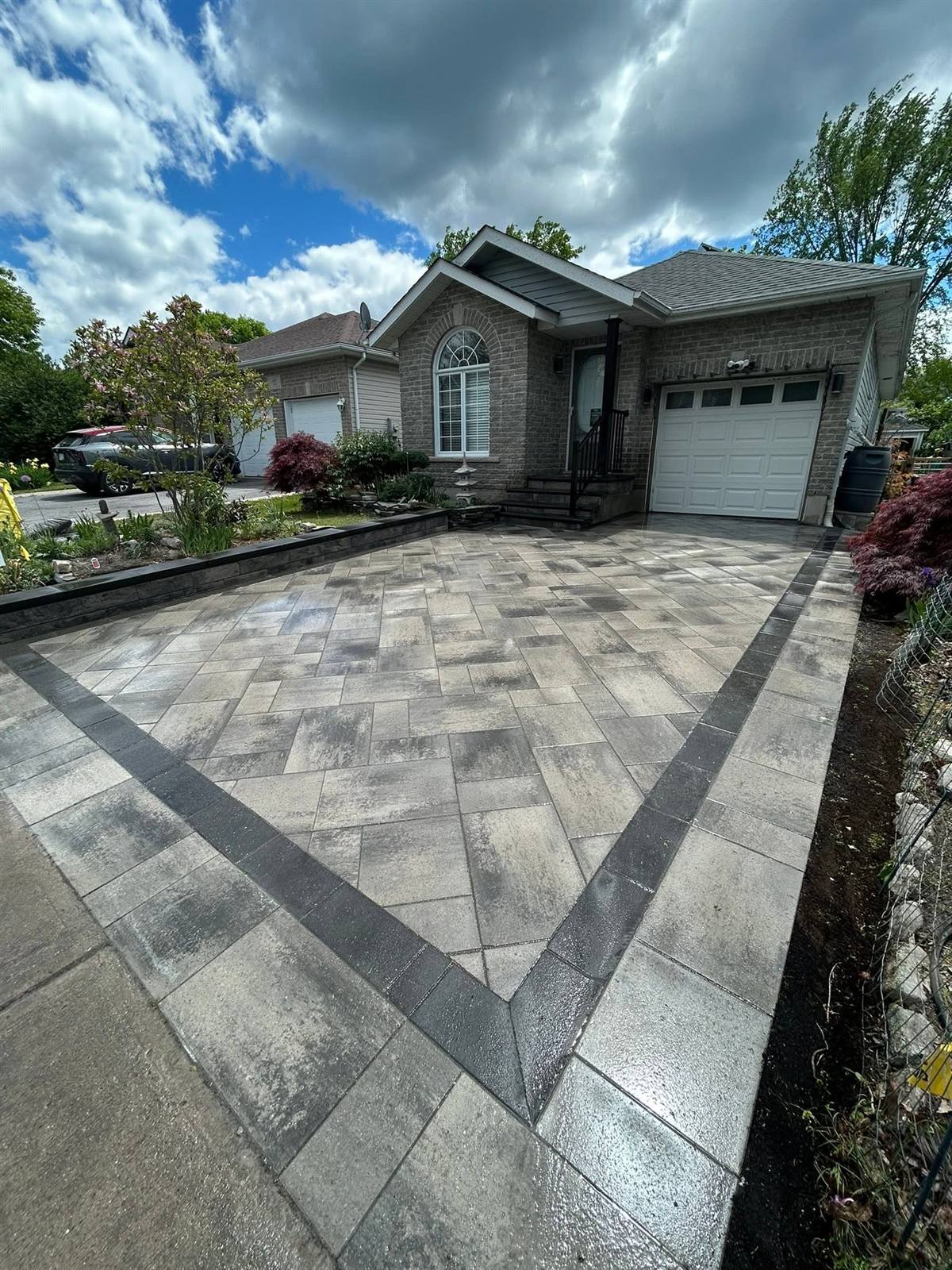
Interlock
The obvious one, and still the biggest. Larger areas cost more in total but often a little less per foot, because setup, delivery and disposal get spread across more ground.
Removing and hauling away an old asphalt driveway or a failing concrete pad is real labour and real disposal cost. Bare lawn is cheaper to start from than a surface that has to come out first.
The part nobody sees and the part that decides whether it's still flat in ten years. Soft or clay-heavy ground needs deeper excavation and more granular. This is where cheap quotes cut.
If a machine can reach the work area, excavation moves quickly. If a narrow gate or a tight side yard means digging and hauling by hand, the same volume of material takes far longer.
Product choice spans a wide range, and pattern matters too — herringbone and diamond layouts need more cutting than a running bond, and every curve adds cuts.
Entry steps, seat walls, retaining walls and any grading needed to move water away from the house are separate structural work priced on top of the flat area.
Decks & fences
Height changes the job more than people expect. A raised deck needs more structure below it, deeper footings, code-compliant railing and a proper stair run.
Pressure-treated is the lower up-front cost and takes stain well. PVC costs more to install and then asks almost nothing of you for decades. Both are good; they're different budgets.
Wood railing is the economical option. Powder-coated aluminum and glass cost more and change the whole look of the deck — especially where there's a view worth not blocking.
Footings go below the frost line so the deck doesn't lift when the ground freezes and thaws. Rock, tree roots or poor access make that dig harder and slower.
Depending on height, size and setback, a City of Kingston building permit may be required. We tell you honestly when one is needed rather than pretending it isn't.
Pergolas, integrated step and railing lighting, privacy screens and built-in benches are all priced separately so you can decide what's worth it to you.
Interior renovations
Keeping the toilet, tub and vanity roughly where they are is meaningfully cheaper than relocating them. Moving plumbing and electrical is where renovation budgets usually grow.
Vinyl plank goes down quickly. Tile is slower, more precise work — and a custom tiled shower needs a properly waterproofed assembly underneath it that you'll never see but absolutely need.
The same layout can be finished at very different price points. We'll tell you where spending more genuinely lasts longer and where it's purely taste.
Older Kingston homes occasionally reveal an out-of-level subfloor or old water damage once the finishes come off. We flag anything we find and price it before doing the extra work.
Reading a quote
On an interlock job, the pavers are the part you see and a minority of the actual work. The base underneath — how deep it's excavated, how well it's compacted, whether there's geotextile between soil and granular, what goes in the joints — is what determines whether the surface is still flat and weed-free after a decade of Kingston freeze-thaw and plow season.
None of that is visible on the day the job finishes. Two driveways can look identical in week one and be in completely different condition by year three. That's why a quote can come in low: something under the surface got shortened.
So when you're comparing quotes, ask every contractor the same three questions. The answers tell you far more than the total at the bottom.
Ask every contractor
Our quotes are itemized specifically so you can see those line items instead of one lump sum labelled “driveway”.
Common questions
The only way to price it honestly is to see it. Book a free site visit and you'll get a written, itemized quote — no obligation.
Request a Free Quote →Materials & partners we build with